
Stop Waiting for Someday: How the Enough Audit Changed the Way I See My Life
Previously, I shared about sitting at the Red Skiff in Rockport, watching Clark's human order his "usual" and longing for that kind of belonging. I talked about how I'd been dismissing my regular life as "not the dream yet"—caught up in Pinterest boards and future plans instead of recognizing the dream life happening right now.
Today, I want to get practical about how we stop waiting for permission to call ordinary moments our dream life.
If you missed part one (Rockport + Clark’s human), you can read it here: Anchored in the Everyday: Notes from Rockport
How We Keep Moving the Goalposts
Hear me when I say this: goals and dreams are not the problem. They're necessary and beautiful. The problem is when the dream life becomes a carrot dangling in front of us as we walk endlessly on life's treadmill. Each time we get close, the goalpost moves further out.
Having goals gives us trajectory, direction, hope. But who's defining these goals? Are they truly yours, born from your own desires and values? Or are they borrowed from societal pressure, Instagram feeds, and the voices that whisper you're not doing enough, being enough, achieving enough?
This obsession with chasing isn't just personal — it's cultural. We've even built frameworks that promise a neat, step-by-step path to fulfillment. Frameworks like Maslow's hierarchy of needs.
The Maslow Question
Maslow's hierarchy of needs offers a path: meet your basic needs, find security, build a sense of belonging, develop self-esteem, and finally reach self-actualization. It's seductive in its simplicity, like a video game where you level up toward ultimate happiness.
But the pyramid has a problem nobody talks about. Maslow himself spent most of his research on self-actualization, studying people he considered already self-actualized including Abraham Lincoln, Albert Einstein, and Eleanor Roosevelt. Not a single one of them described feeling done. They were curious, restless, still reaching. Not because they hadn't arrived, but because self-actualization, as Maslow actually defined it, isn't a destination. It's an ongoing process of becoming. The pyramid was always the wrong image for it.
And the research has been catching up to that ever since. A 2011 study published in the Journal of Personality and Social Psychology tested Maslow's hierarchy across 123 countries and found that the needs don't actually stack the way the model suggests. People pursue connection, meaning, and self-expression even when lower-tier needs aren't fully met. The tiers bleed into each other. The neat climb was always a simplification.
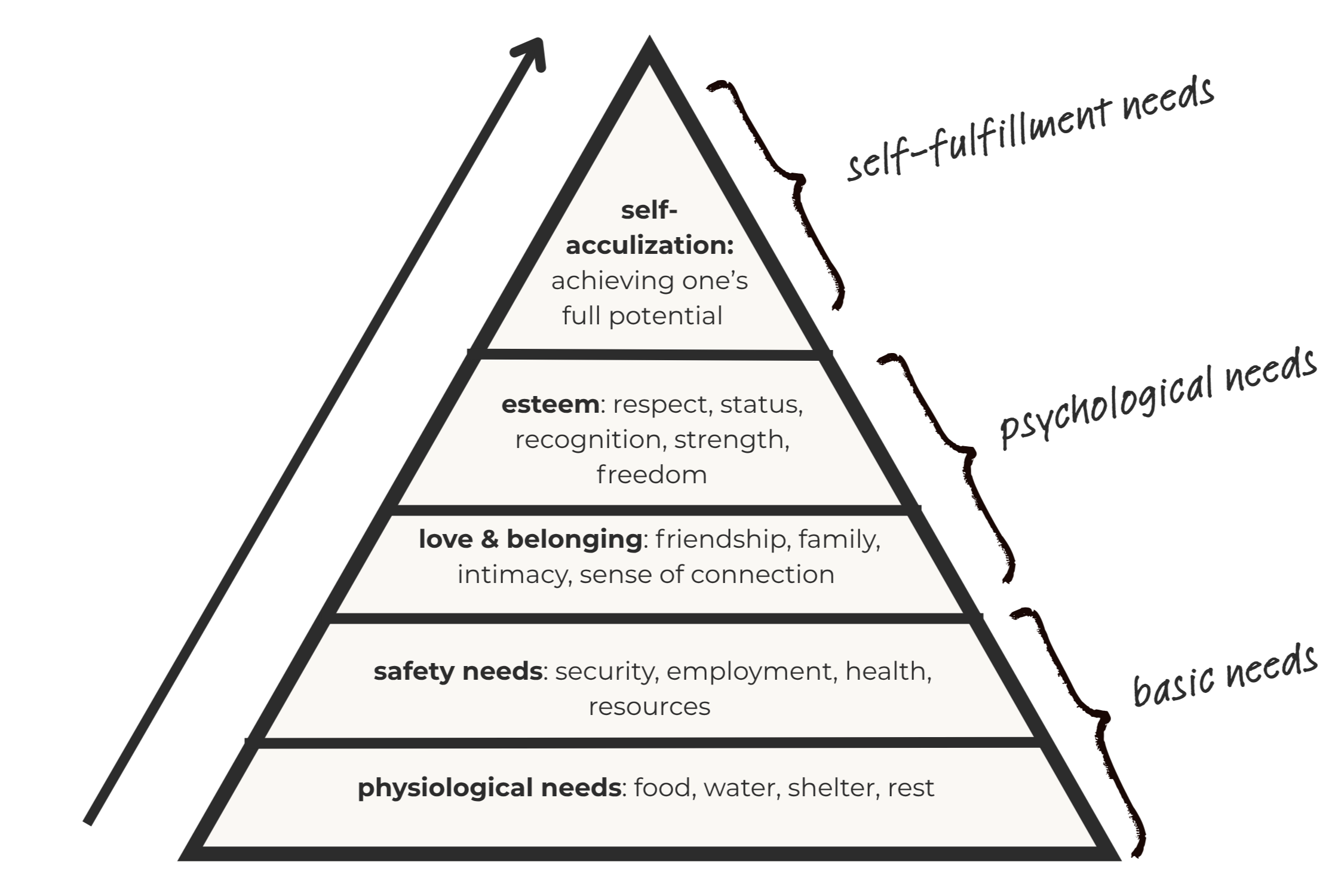
And nowhere is that clearer than with creativity and connection. Maslow placed self-actualization at the very top — something you reach only after everything below it is secured. But the evidence tells a different story. Vincent van Gogh created some of his most transcendent work while struggling with poverty and mental illness. Anne Frank wrote with profound self-awareness and purpose while in hiding, basic safety stripped away entirely. Maslow himself argued that painters need to paint, writers need to write, musicians need to play — that this drive toward creative expression is self-actualization, not the reward for achieving it. More recent research building on Mihaly Csikszentmihalyi's work on flow states confirms this: creativity isn't something you unlock after you've sorted your life out. It's one of the ways you sort your life out. The same goes for belonging — you don't graduate from needing your people. Community and creativity aren't steps on the way to a meaningful life. They're what a meaningful life is made of.
Which means the thing you've been waiting to feel, that sense of enough, of finally being where you're supposed to be, isn't locked behind the next milestone. It's available right now, on an ordinary Tuesday, regardless of where you think you are on the pyramid.
The Selling of Dissatisfaction
And this isn't an accident — it's by design. Our culture thrives on keeping fulfillment just out of reach. The endless optimization we're sold — the routines, the hacks, the challenges, the courses — feeds an economy built on our perpetual wanting.
Every "New Year, New You." Every productivity hack promising to unlock your potential. Every supplement to make you younger, every "lock-in" challenge, every "winter arc" transformation. All of it sells the same lie: that fulfillment is always one purchase, one habit, one optimization away.
But here's the truth: we're not broken, we're not behind, and we're not missing a secret step. When we're constantly striving without ever arriving, all we're left with is the selling of our own dissatisfaction.
I realized I had bought into a promise of a dream life that was always out of reach. But maybe the trap was the promise.
And that's when I began to wonder: what if the way forward isn't more striving, but stopping?
Permission to Stop
If the promise itself is the problem, then maybe the real rebellion is giving ourselves permission to stop — not to quit, but to say enough. To call Tuesday morning coffee in our pajamas the dream life without needing to earn it first.
When I first realized I was treating my life like a rough draft, I was angry. But maybe instead of chasing the dream life, we need to chase enough.
We've heard of life audits. But what about an Enough Audit?
The Enough Audit — A Free Noticing Practice
This is where I want to be honest with you about what the Enough Audit actually is — because it's not a productivity tool, a vision board exercise, or another thing to optimize.
It's a quiet practice of noticing.
I built it after a layoff and my mom's cancer diagnosis hit the same year. It was the first time I stopped chasing long enough to look around. What I found changed everything — not because my circumstances were suddenly perfect, but because I finally stopped sprinting past what was already here.
The Enough Audit is three questions at its core:
What does my dream life actually look like — not the curated version, the real one?
Where is my current life already touching that?
What do I want to grow next — on my own terms, not anyone else's?
That second question is the one that stops people. Because when you put your dream life and your current life side by side, you almost always find more overlap than you expected. Not a perfect overlap. Not done. But touching. Already here, in seeds, in small Tuesday moments you've been sprinting past on the way to someday.
Here's what that looked like for me:
I want a vegetable garden in my dream life. I currently have three small garden beds in my parents' backyard. That is enough. I'll keep tending and growing — but right now, this is my dream life happening.
I want to create content that helps people realize they're already living their dream life. I may not have 100,000 followers or six-figure months. But I am living my dream life right now. And I am helping you realize yours.
The Enough Audit won't tell you to stop wanting more. It will help you stop missing what's already here while you wait for it.
What If the Dream Life Is Already Disguised as Ordinary?
Maybe that's what Clark's human understood that morning at the Red Skiff — that his "usual" wasn't something he had to earn, optimize, or unlock. It was simply Tuesday morning, bacon for the dog, coffee in hand — the dream life disguised as ordinary life, lived one gentle moment at a time.
The average Tuesday is not something to survive on the way to someday.
It might already be the dream. You just need to stop long enough to name it.
What would you name as enough, right now? Leave it in the comments — or just sit with it. Either way, I'm cheering you on.
