
Why Achieving Your Goals Still Feels Empty (And What to Do About It)
The science behind why the goalposts keep moving and the question that finally changes the game.
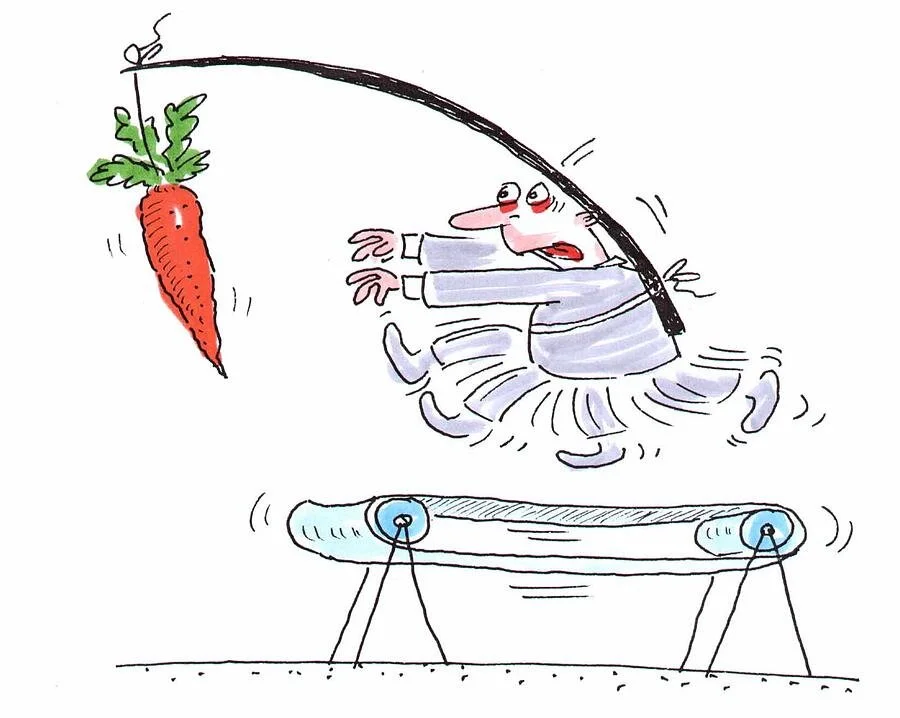
Man On A Treadmill Desperately Trying To Get At A Carrot by Martin Guhl
Congrats, you achieved your goal! Maybe it was the promotion. The apartment. The degree. The number on the scale. Whatever it was, you worked hard for it. Hustled, planned, and achieved it. All the while telling yourself that once you had it, you’d finally feel like enough.
Spoiler: you didn’t feel like enough.
You achieved this goal, and you felt fine. Proud, elated, even… but just for a bit. And poof, the next goal appears, usually within a week. And suddenly you feel you’re on a treadmill with a carrot dangling in front of you.
If this sounds familiar, take comfort in the fact that you're not alone and that there is a scientific explanation for what you are feeling.
You're experiencing something psychologists call the arrival fallacy — and it's not a personal flaw. It's a feature of how the human brain is wired.
The problem is that nobody tells you that while you're busy chasing.
Why Achieving Goals Doesn't Make You Happy: The Science Behind the Arrival Fallacy
Here's the science bit, and I promise it's more validating than it is depressing.
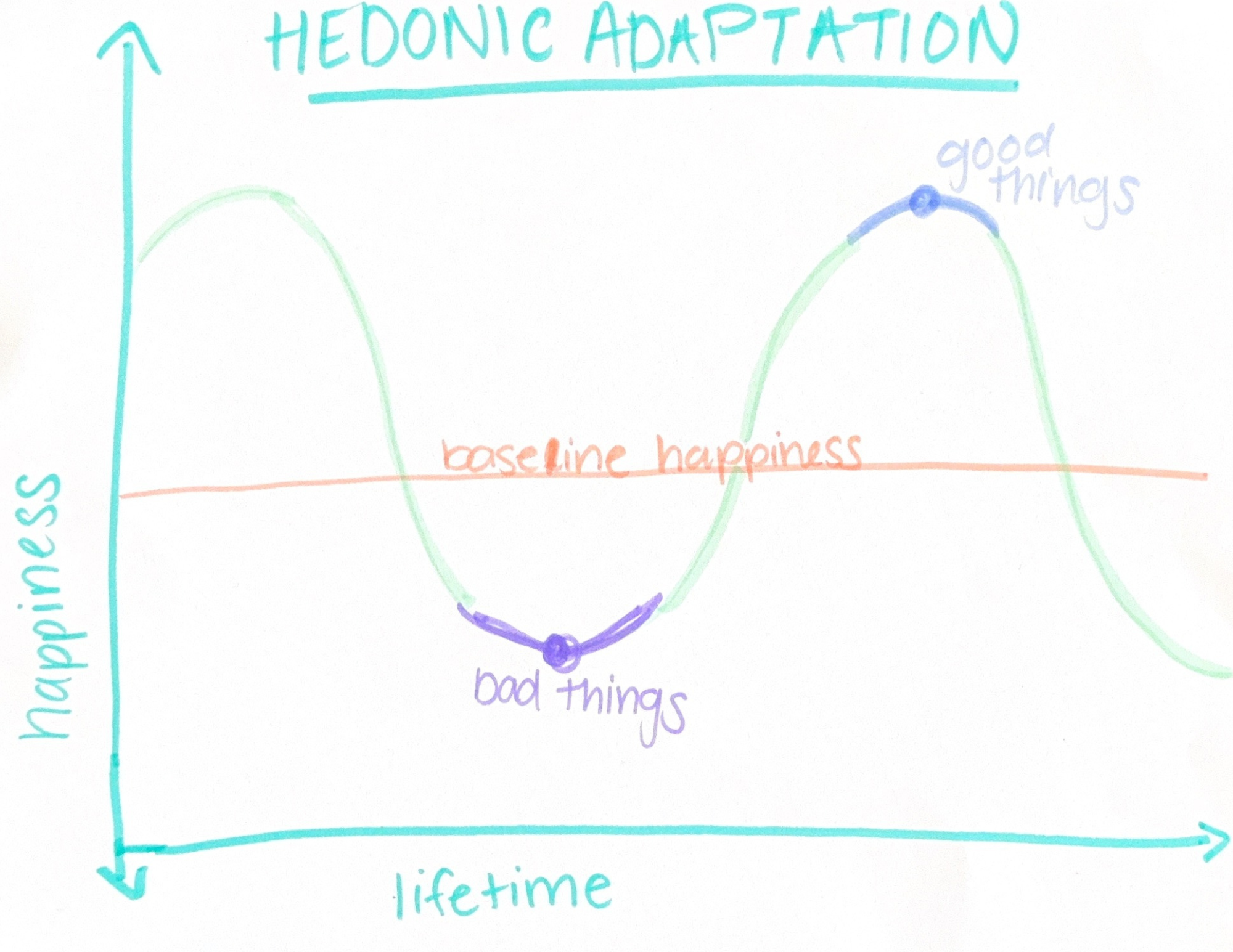
There's a phenomenon called hedonic adaptation. It's the brain's tendency to return to a baseline level of happiness after any significant event, positive or negative. Let me break it down for even more: you get the promotion, feel genuinely good for a few weeks, and then it just becomes the new normal—your baseline resets. The brain, being the efficiency machine it is, has already moved on to the next thing to want. That’s where you get the idea of the hedonic treadmill (where people continuously seek new stimulation to maintain happiness levels).
Dopamine — the chemical most people associate with happiness — actually spikes during the pursuit of a goal, not after you achieve it. Which means the brain is literally wired to make the chase feel better than the arrival. Dopamine can be fickle that way.
So, of course, nothing ever feels like enough. You were never supposed to stop wanting. Your brain has a vested interest in keeping you moving. And so does capitalism, our phone screens, and social media apps. You are literally fighting an uphill battle.
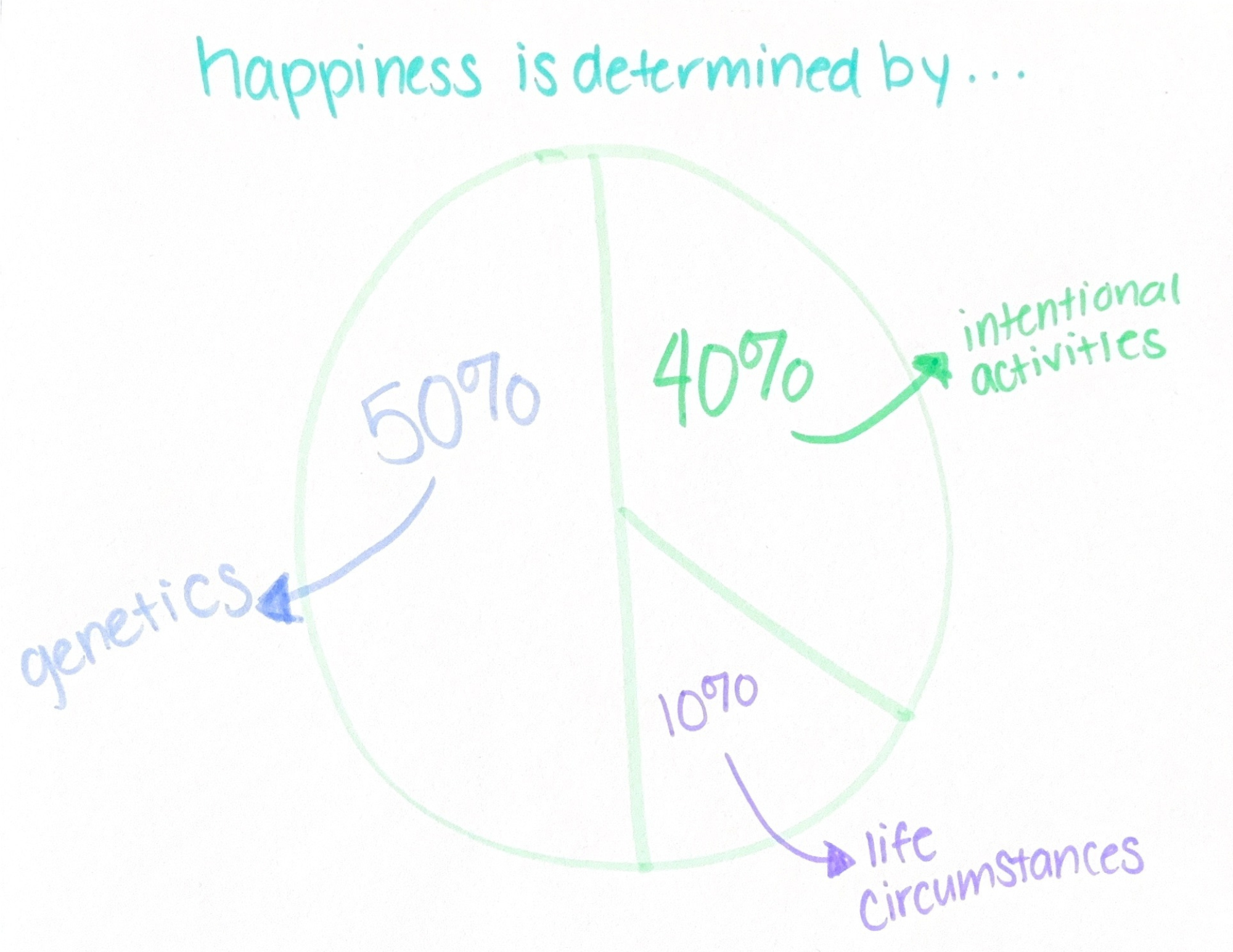
And then there's the 50/40/10 rule, from researcher Sonja Lyubomirsky's 2005 study. It found that roughly 50% of our happiness is determined by genetics, aka our baseline temperament. About 10% is life circumstances: your job, your income, where you live, your relationship status, etc., or better known as the things we spend most of our energy trying to change.
The remaining 40%? Intentional daily choices and activities. How we spend our attention. What we practice noticing. What we decide means something. These are your conscious actions, thoughts, and behaviors. 40% of your happiness is within your control; you can increase joy through daily choices.
That 10% — the circumstances — is what the arrival fallacy has us chasing. We're burning ourselves out optimizing the smallest lever in the equation.
When the Arrival Fallacy Is About Identity, Not Achievement
This is the part that took me the longest to see.
I spent years running a when/then operating system. When I get this job, then I'll feel settled. When I move there, then I'll feel at home. When I reach this milestone, then my real life begins. I wrote about the full spiral of it here — the Gilmore Girls dream life, the Scotland master's degree. I labeled certain milestones as failures before they were even over because they didn’t look like what I had envisioned, or, in reality, because my dopamine baseline had leveled out and the hedonic treadmill started back up again.
But beneath all those external goalposts lay a quieter, more dangerous layer. The constant spiraling thoughts of: Once I figure out who I am. Once I stop needing other people's approval. Once I've earned the right to just... be
That version of arrival fallacy isn't about achievement, it's about self. And it's the version that keeps you stuck the longest because there's no finish line to cross. No milestone to check off. Just a moving target made entirely of your own becoming.
And here's the cruel irony: all the optimizing, the striving, the chasing, it doesn't find her. In fact, it buries you.
Cause babe, you can't hustle your way to knowing who you are. Trust me, I tried.
How to Stop Chasing Happiness: Ask This Question Instead
Most of the advice around this topic tells you to practice gratitude. Slow down. Be present. And those things aren't wrong, exactly. But they're not quite right either. Because the problem isn't that you're not grateful, it's that you've been measuring your life with someone else's ruler for so long, you don't even remember picking it up.
The arrival fallacy keeps running because you're asking the wrong question.
You've been asking: am I doing enough?
The right question is: is this even mine?
That shift — from measuring output to questioning the metric itself — is where something actually changes because it interrupts the loop of self-talk.
It makes you look at what you're actually chasing, and whether you chose it, or whether it just seemed like the right thing to want (ahemm social media, societal pressure, capitalism hellhole).
I can't think myself into living. I noticed my way into it by stopping, looking at what was already here, and asking what it would mean to call this enough.
What to Do About Arrival Fallacy: Start a Noticing Practice
I want to give you something practical because I know the impulse when you're reading something that names what you've been living and you want a next step so you can fix it… and oh, what’s that, get that dopamine hit…
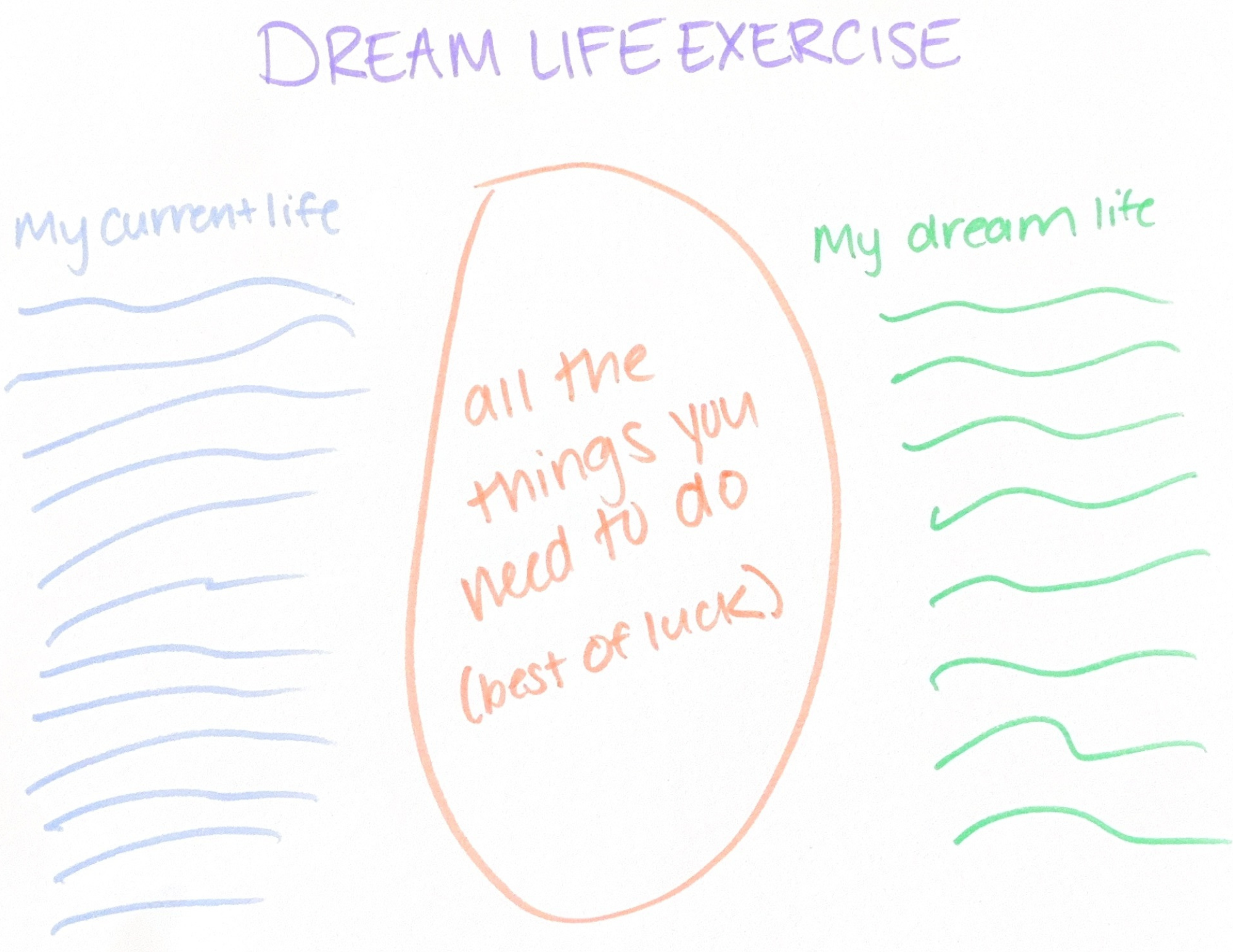
I want to be honest with you, what helped me wasn't another system. It wasn't optimization. It was a noticing practice. I call it the Enough Audit. It's not a productivity tool. It's three questions that help you look at what's already here and start naming it, before you sprint past it.
The core question at the center of it: what if your dream life is already happening and you just haven't named it yet?
For a lot of us, that hits differently. So many dream-life exercises start with here's what you want, here's what you have, here's the gap. And then you spend your whole life staring at the gap. So I flipped it.
I want a huge garden in my dream life with veggies and flowers that I spend my mornings tending to and my evenings wandering through. Well, currently I have three small garden beds in my parents’ backyard. That is enough! I’ll keep tending and growing, but right now this is my dream life. Do you remember the 40% — the intentional daily choices and activities? We've been so busy proving and chasing and justifying that we haven't stopped to actually notice the life we're in.
You can find the Enough Audit below. It's free. It's not a 30-step overhaul. It's a place to start noticing.
The arrival fallacy is not a willpower or a discipline problem; it's a measurement problem. And you can't solve a measurement problem with the wrong ruler.
You're not waiting because you're lazy, ungrateful, or broken. You're waiting because you were handed a when/then operating system so early, and reinforced it so thoroughly, that waiting started to feel like responsibility. Like being realistic. Like the smart, sensible thing to do. It isn't.
Your life is not a practice round. The in-between is not a waiting room. And the average Tuesday — this one, the one you're in right now — is not something to survive on the way to someday. That Tuesday might already be the dream. You might just need to notice long enough to name it.
